Beef ball 牛肉丸
Made with beef as the principal meat ingredient. The finished bite can vary with the meat, formulation and processing; appearance alone cannot confirm its contents.
Why this food belongs to Chaoshan, how the product is defined and made, and what the evidence can tell a buyer.
There is no single definitive origin story. Understanding the food means looking beyond the meatball itself: at the region’s wider beef-eating culture, its approaches to handling fresh meat, and the importance placed on texture.
These connections also help explain how something associated with local food shops became a regional product with a much wider reach.
FIELD QUESTION / 001
PLACE · PRACTICE · TEXTURE · MARKET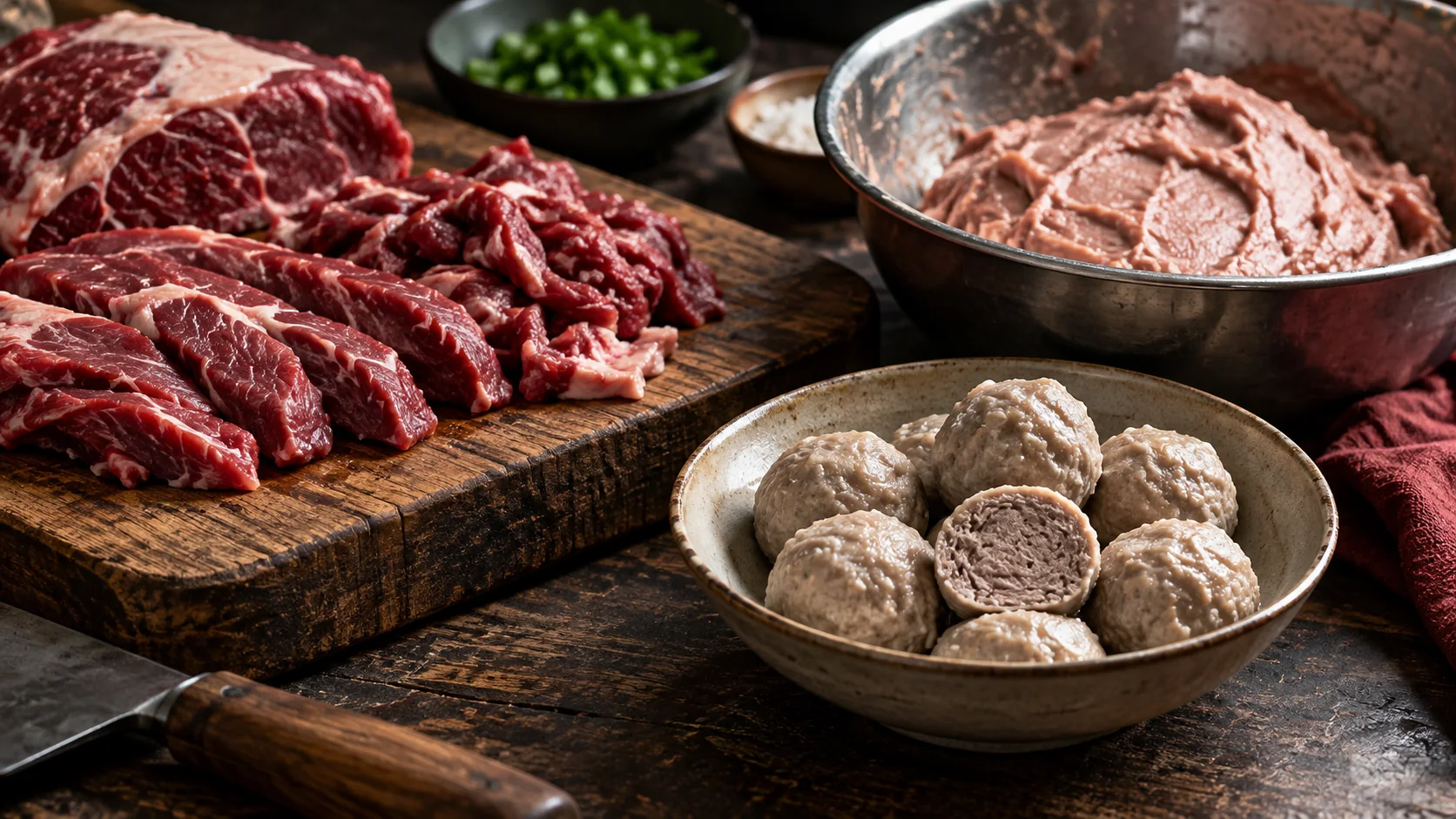
Beef balls belong to a much wider way of preparing and eating beef in Chaoshan.
Freshly sliced cuts, short cooking times and beef balls are brought together in the regional hotpot tradition. The Chaozhou beef-hotpot group standard sets out different cuts and cooking methods, and includes beef balls and beef-tendon balls in the same meal.
This shows how the product fits into a broader food system. It does not, by itself, establish when or where beef balls were invented.
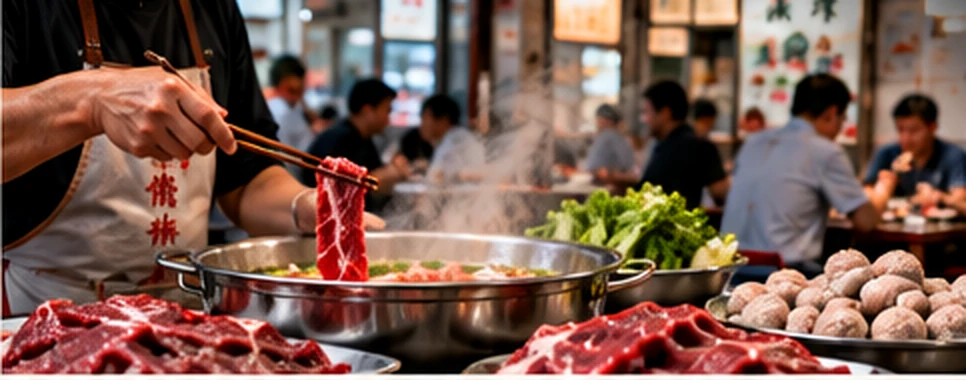
In the Chaozhou beef-hotpot tradition, freshness is described not only as a taste preference but also through sourcing and preparation practices.
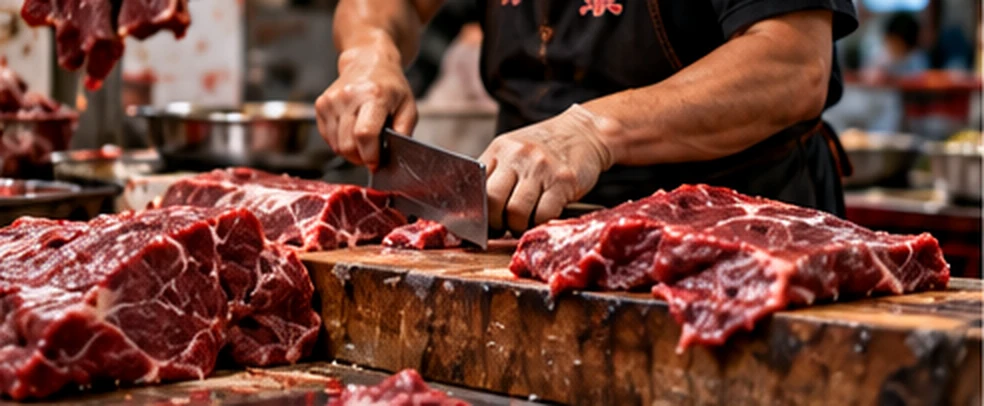
A recommended freshness window reported for yellow-cattle beef used in Chaozhou beef hotpot, under a hotpot group standard—not a production requirement for packaged beef balls.
This is not a universal requirement for Chaoshan beef-ball production. It is a provision in a beef-hotpot group standard, not a rule for every packaged beef ball.
Guangdong’s DBS 44/005—2024 standard for Shantou beef balls permits both fresh and frozen cuts of beef as raw material.
Freshness matters in the local food culture. Modern commercial production follows a broader set of accepted raw-material conditions.
Springiness is not just a food writer’s description. Guangdong’s standard for Shantou beef balls sets out how the finished product should respond to pressure and what to examine on its cut surface.
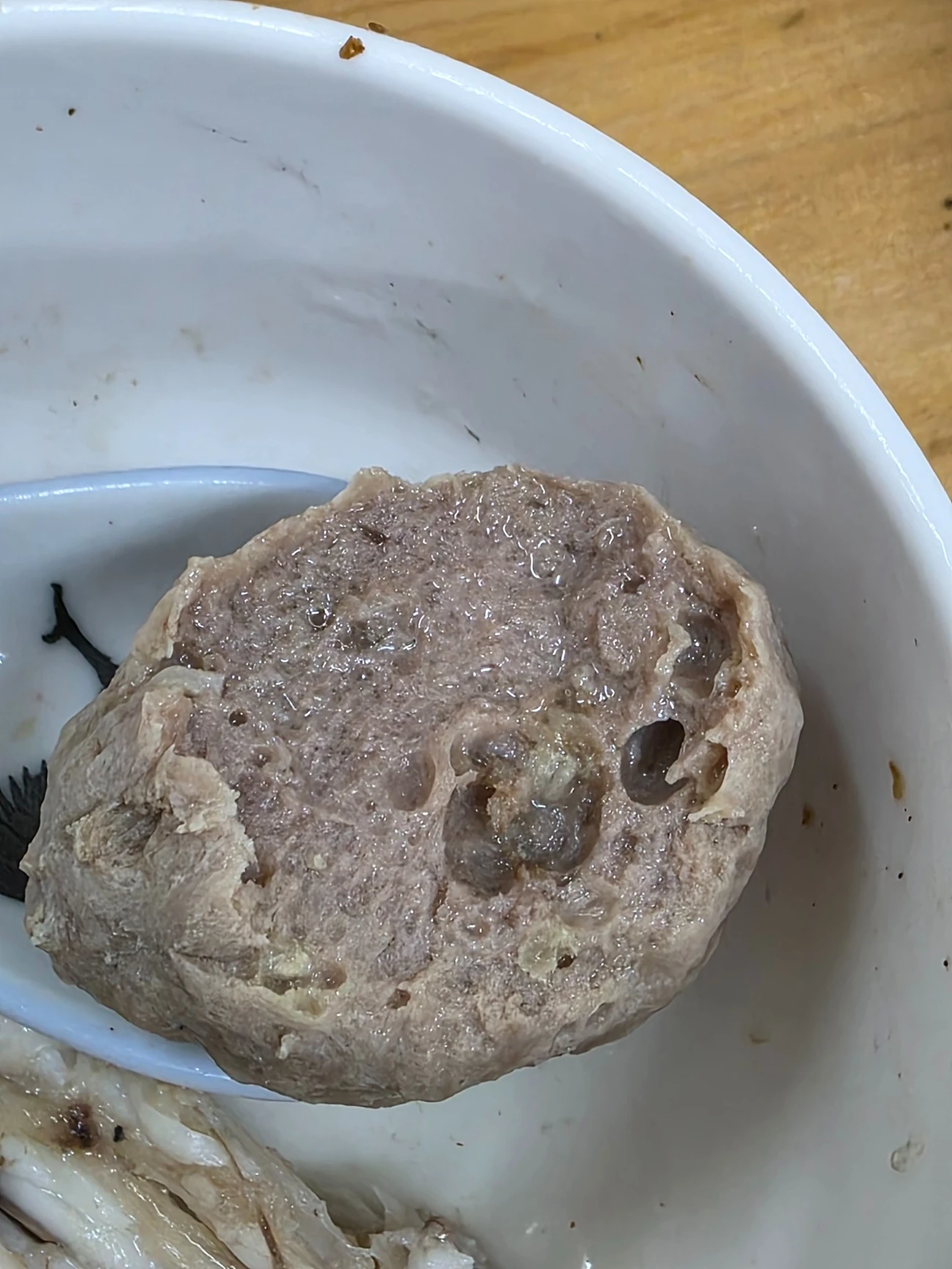
ELASTIC.
Should recover quickly after finger pressure.
The standard describes pores of varying sizes, distributed unevenly.
It specifies a physical press test and visual examination after the ball is cut open.
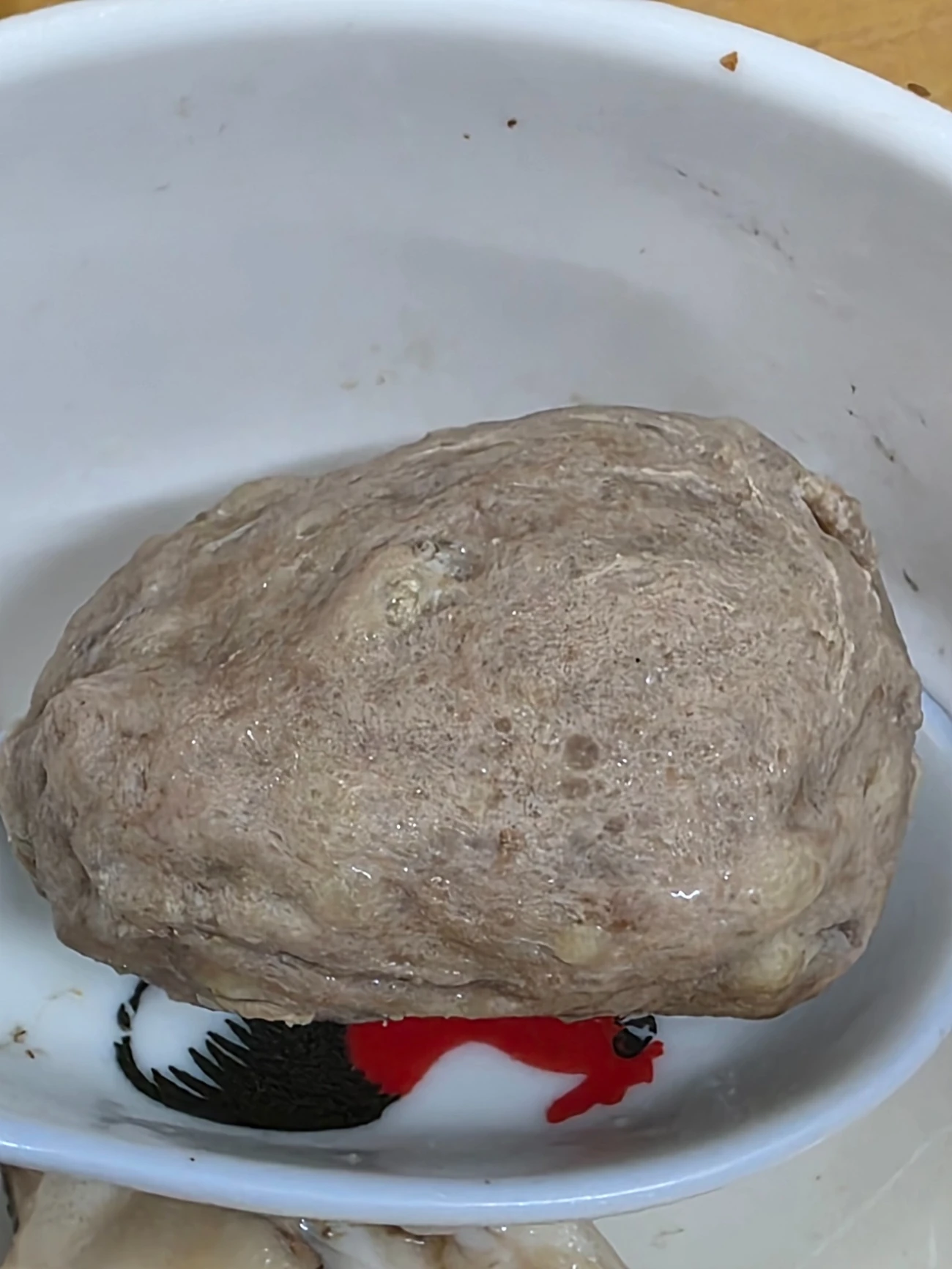
Real sample photographs can help readers see the whole form and internal structure. They do not demonstrate rebound, food safety, or conformance with the standard.
Chopping, salt-soluble muscle proteins and controlled heating all influence the gel structure that contributes to a beef ball’s texture. The processing explanation comes from food-science research, not from an analysis of this photographed sample.
Read the beef-meatball processing review ↗Beef balls are still closely associated with local eating. They are also produced by licensed manufacturers using controlled processes, packaging and distribution beyond Chaoshan.
These are two parts of the present-day food economy — not evidence that every maker uses the same methods.
Beef shops and restaurants remain a familiar setting for the food.
Reported manufacturers use production lines, quality checks and packaging.
Packaged products can move into wider regional retail and distribution.
In a report republished by Shantou’s municipal government, one named manufacturer was operating three production lines and had produced nearly five tonnes of meatballs in one morning for shipment to Shenzhen.
This describes the reported activity of one company, not an average for the industry. The same report describes cold storage, equipment, in-process checks and finished-product inspections.
Shantou government report / 26 Feb 2025 ↗The standard separately addresses production controls, labelling, storage and transport for Shantou beef balls. It does not establish that all foods sold as “Chaoshan beef balls” have an identical production history.
Read the official standard ↗The historical timeline is less settled than the modern product standard.
A Guangdong CPPCC publication cites an account of Luo Jinzhang beginning to sell beef balls in Shantou in 1921.
View cited account ↗A heritage narrative published by the Ministry of Commerce's time-honoured-brand museum describes Hakka introduction into Chaoshan around the 1940s.
View heritage account ↗These are published accounts, not conclusive verification of an inventor or a single introduction date. This dossier therefore leaves the precise origin open rather than turning a contested timeline into a definitive claim.
A Chaoshan beef ball is a rounded meat product made from worked beef paste, valued for a close, springy bite. You may meet it in a bowl of soup or hotpot — or in a pack far from the place it is associated with.
But a regional food name is not, by itself, proof of a particular recipe, composition or manufacturing method.
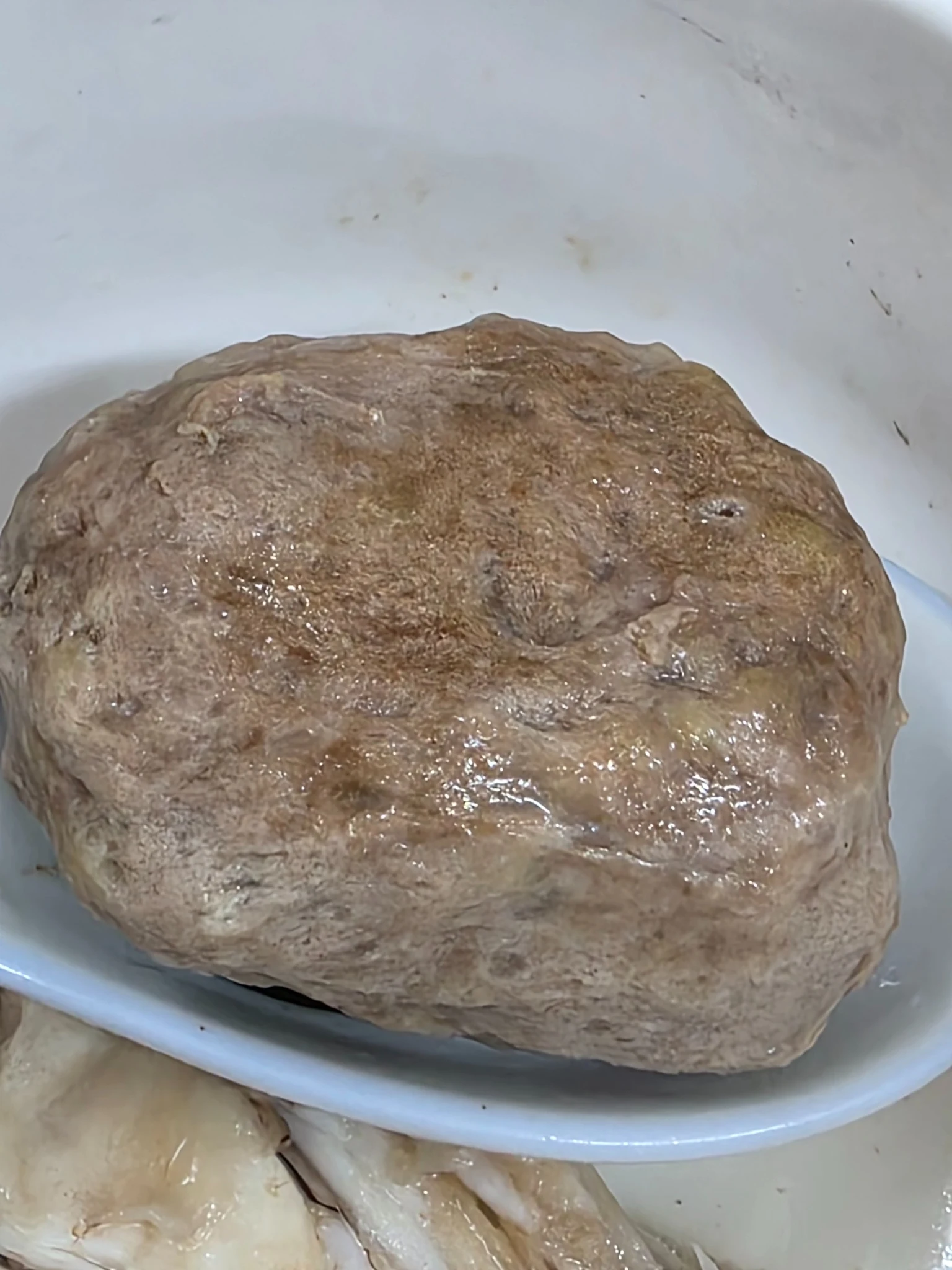
The distinction starts with the ingredient declaration — not the photograph.
Made with beef as the principal meat ingredient. The finished bite can vary with the meat, formulation and processing; appearance alone cannot confirm its contents.
A related variety that includes beef tendon. That does not establish a fixed percentage or guarantee one particular texture across producers.
The Guangdong standard for Shantou beef balls covers both beef balls and beef-tendon balls. These are common product names, not a photographic identification guide. Official standard ↗
For products covered by the Shantou beef-ball standard, the definition requires either more than 90% beef, or more than 90% combined beef and beef tendon, as applicable.
The standard accepts fresh or frozen beef and traditional pounding or mechanical mincing. Its defined products are not ready to eat and require cooking according to the product instructions.
“Chaoshan beef ball” is the broader regional expression; this numerical definition comes from a standard specifically for Shantou beef (tendon) balls. Neither a photograph nor the printed name alone establishes conformity.
Knowing what a beef ball is should make the next question sharper: how does beef become a springy ball? That belongs to the making process, not an origin legend.
READ THE SOURCE STANDARDThe round shape comes near the end. Before that, meat is prepared, worked into a paste, seasoned, and then formed and set. The method and conditions can differ between makers.
Sequence illustrated below is a research schematic—not a record of one inspected production line.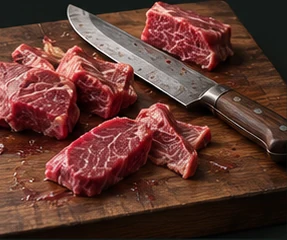
Trim and cut the meat before working it into a paste.
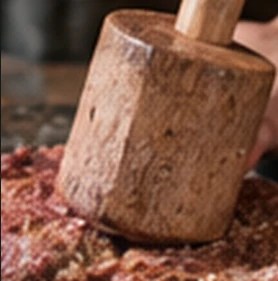
Mechanical work changes the meat into a cohesive paste.
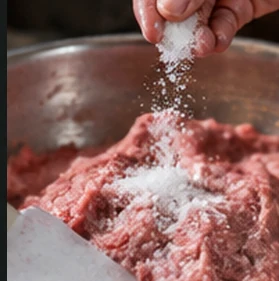
Salt and permitted ingredients are incorporated; the formulation varies.
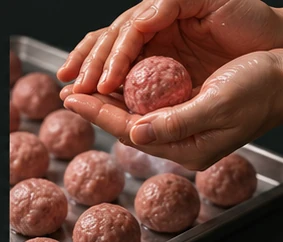
Portion and form the paste by hand or with forming equipment.
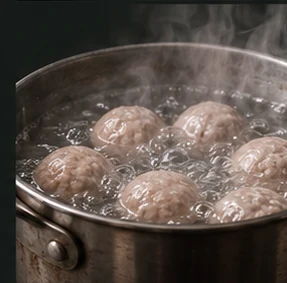
Heating forms the finished structure; stages and temperatures vary.
Working the meat and mixing with salt can help extract muscle proteins. During subsequent heating, those proteins interact to form a gel network that contributes to the ball's texture and water retention.
This is a general meat-science explanation, not a measurement of the samples photographed elsewhere in this dossier or a guarantee that two production methods deliver identical results.
READ THE PROCESSING REVIEWRepeated mechanical impacts work the meat toward a cohesive paste. It is a technique associated with traditional preparation, not proof on its own of a finished product's quality.
Equipment can perform the working stage. Ingredient choices, temperatures, timing and process control still shape the final result.
The Guangdong Shantou beef-ball standard (DBS 44/005—2024) explicitly recognises traditional pounding or mechanical mincing. Neither route, by itself, certifies a batch.
A 2019 Chaozhou cuisine process specification describes one detailed sequence of preparation, machine working, forming, setting and cooking. It includes equipment settings and temperature steps. Those figures belong to that particular group specification and should not be presented as the required formula for every Chaoshan or Shantou producer.
Food safety boundary: the products covered by the Shantou local food-safety standard are defined as not ready to eat. Consumers should follow the cooking directions on the actual product label; a diagram here is not cooking guidance.
Two products sold as “Chaoshan beef balls” may differ in formulation, packing, handling and market eligibility. Before comparing offers, establish what the supplier is actually selling.
This is a buyer's reading guide, not a certification of any product or a promise that it can be imported.
The Shantou local standard specifies information for products within its scope. For a real order, buyers need the actual SKU label and supporting product documents.
Beef ball or beef-tendon ball; exact product name and applicable standard
Full ingredient list, declaration of beef or beef-plus-tendon content, and relevant allergens
The Shantou standard covers non-ready-to-eat prepared meat products
Actual label instructions, storage conditions, date coding and shelf life
Confirm the declared net contents, not just the bag size.
Ask for the SKU's unit weight or count range. Do not assume industry-wide sizes.
Retail pouch, foodservice bulk or other format? Match it to the sales channel.
Confirm the validated shelf life for the product under its stated storage conditions.
These are the conditions stated in DBS 44/005—2024 for products within that standard's scope. They are not a universal shipping specification for all meat products or destination markets.
Transport and storage range specified for chilled products.
Transport temperature should not exceed −12°C; after unloading, bring the product below −18°C as soon as possible.
Frozen storage at or below −18°C, with temperature variation controlled to ±2°C, under the local standard.
Before placing a cross-border order, verify whether the destination country accepts that meat product from China, whether the source establishment and processing category are eligible, and which health certificates, import controls and local-language labelling rules apply.
For example, the United States applies country, establishment and product eligibility requirements to many imported meat products under USDA/FSIS. The rules depend on the exact product; the Shantou domestic standard alone does not establish US import eligibility.
USDA / FSIS IMPORT GUIDANCEName, composition, beef/tendon content, piece size, net weight and pack format.
Real pack images, ingredient declaration, cooking directions, date coding, shelf life and temperatures.
Applicable destination-market eligibility, required certificates and relevant batch quality records.
Who actually makes it, who sells it, and who can supply your destination? The answers may involve different businesses.
This section maps evidence of the industry. It is not a supplier ranking, an approved exporter list, or a live count of available factories.
Food-production businesses licensed for beef-ball products in Shantou, as reported in February 2025.
SHANTOU GOV. · 26 FEB 2025Beef balls supervised for export by Chenghai Customs in December 2024, according to a January 2025 report.
SHANTOU GOV. · 19 JAN 2025These are commercial roles to distinguish when researching a specific offer, not an exhaustive classification of Shantou companies.
The facility making the exact SKU. Trace the production licence, product scope and manufacturing address to this entity.
The company packaging, marketing or offering the product may not operate the plant. Confirm which party owns the SKU and contracts the production.
Cross-border supply brings separate questions about the exporter, the eligible plant, documents, cold-chain route and importing market.
Named businesses appear here only because published reporting describes a specific operation at a specific date. Neither entry is a verified supplier recommendation.
Government reporting described three production lines operating during a February 2025 visit, with nearly five tonnes produced in one morning for shipment to Shenzhen.
A customs-related government report described beef balls being packaged for overseas orders and customs guidance on production control and destination requirements.
These accounts do not establish current capacity, pricing, ownership, licences, certifications or eligibility for any particular foreign market. Obtain updated documents directly from the relevant parties and check them against official records.
A useful inquiry should reveal the product, the actual plant, and the route into the destination market. Work from evidence, not badges on a sales page.
Full ingredient declaration, formulation standard, pack form, storage mode and supporting product specification.
Manufacturing company, facility address, production licence and whether its permitted scope covers this product.
Relevant test records, shelf-life basis, handling conditions and traceability information for the exact offer.
Market access for China-origin meat products, facility eligibility, required certificates, exporter/importer roles and cold-chain logistics.
Shantou's market regulator continues to emphasise truthful labels, raw-material checks, inspection systems and food-safety responsibility for local meat processing. This is a regulatory context, not a supplier-quality rating.
SHANTOU MARKET REGULATOR / 24 APR 2026 ↗